

Sometimes you only realize how dependent you are on electricity when it suddenly goes off. The fridge stops humming, the lights stay dark, the cell phone mercilessly displays the last percentage point. Power cuts are usually short and harmless, but what if they last longer? Days or even weeks? Then convenience quickly turns into seriousness.
And this is exactly where power banks, batteries and rechargeable batteries come into play. They are not large generators or backup power stations - but they are handy, flexible energy reserves. In an emergency, they can be crucial: for communication, light, medical devices or simply to maintain a bit of normality.
Why mobile energy is so important
Electricity is more than just convenience. It is safety. With a charged cell phone, you can call for help, call up information or coordinate with others. A headlamp keeps your hands free at night. A small radio keeps you up to date with developments.
If there is no energy, you are cut off. In a blackout, this is perhaps the greatest danger: isolation. Batteries, rechargeable batteries and power banks are therefore like little life buoys in a dark sea.
Various energy storage systems at a glance
Not all mobile energy sources are the same. They differ in terms of capacity, durability and possible applications.
Batteries - the classics
- Disposable products, ready for immediate use.
- Long shelf life, often 5-10 years.
- Ideal for devices with low consumption (flashlights, radios).
Rechargeable batteries - the rechargeable ones
- Longer lifespan, as it can be recharged multiple times.
- However, they require regular care and recharging.
- More environmentally friendly than disposable batteries.

Powerbanks - the all-rounder for USB devices
- Store large amounts of energy for smartphones, tablets, headlamps.
- Portable and flexible.
- Different capacities – from „charge cell phone once“ to „several days of power supply“.
Comparison at a glance
| Energy source | Advantages | Disadvantages | Recommendation for preppers |
| Batteries | Long shelf life, ready to use immediately | Can only be used once | Mandatory for basic devices |
| Batteries | reusable, environmentally friendly | need charger and maintenance | Useful with solar option |
| Powerbanks | High capacity, versatile | Capacity decreases over the years | Indispensable for communication |
Which devices absolutely need energy
You shouldn't want to load everything up. A clear focus on the essentials is crucial.
- Cell phone (communication, emergency call, navigation).
- Flashlight/headlamp.
- Radio (crank or battery operated).
- Medical devices (e.g., inhaler, blood glucose meter).
Useful extras:
- E-book reader or tablet (for information, but also against boredom).
- Small fans or heating pads (depending on the season).
Everything else - coffee machine, television or laptop - belongs in the luxury category.
Power banks - what to look for?
Not every power bank is suitable for emergency preparedness. Many are made for everyday use: a quick charge and you're done. In a crisis, other criteria count.

Important points:
- Capacity - measured in mAh (milliampere-hours). For real emergency provision from 20,000 mAh upwards.
- Outputs - multiple ports are practical, especially with USB-C and fast charging function.
- Charging options - Compatible with solar panels or crank generators.
- Robustness - Shockproof, water-resistant, not too sensitive.
A personal tip: It's better to have two medium-sized power banks than one huge one. If one fails, you still have a spare.
Manage batteries correctly
Batteries are practical, but only if you maintain them regularly. Leaving them unused for years often results in a nasty surprise.
Tips for use:
- Recharge the batteries every few months.
- For longer storage, charge only partially (40–60 %).
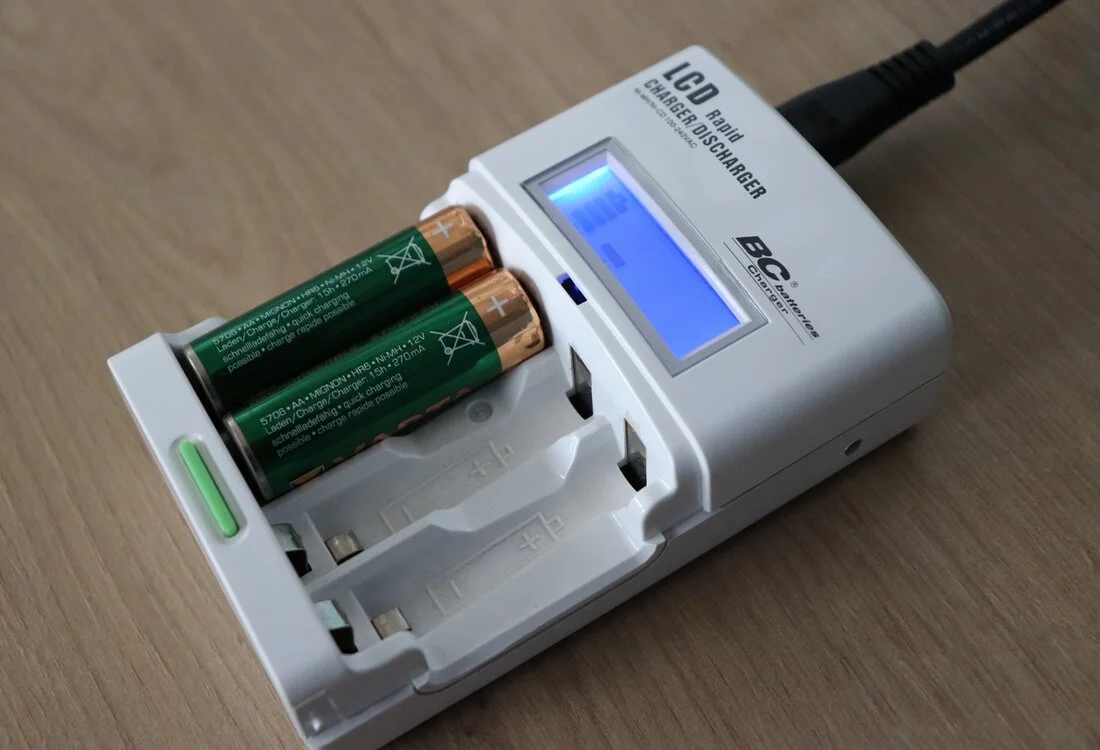
- Use a charger with a discharge and refresh function.
Combined with a small solar panel, rechargeable batteries are a sustainable solution for lighting and small appliances.
Batteries - underestimated classics
Often ridiculed, but worth their weight in gold in an emergency: alkaline or lithium batteries. They are robust, available everywhere and have an incredibly long shelf life.
- AA and AAA These are universal sizes; they work with almost every device.
- Lithium batteries last an extremely long time, even in the cold.
For example, a small radio powered by AA batteries can run for weeks—something no power bank I can't do that for that long.
Strategies for Preppers - How to Plan for Energy
It's not enough to simply throw batteries in the cupboard and put a power bank on the shelf. Prevention needs a system.
Step by step:
- Determine requirements
- Which devices have to run and for how long? - Calculate Capacity
- Do you charge your cell phone every day? Do you use the flashlight for 2 hours in the evening? The power supply depends on this. - Create redundancy
- Combine batteries, rechargeable batteries, and power banks. - Plan charging options
- Solar panel, hand crank, emergency car power. - Storage & maintenance
- Cool, dry, check regularly.
Sample calculation
On average, a smartphone requires approximately 3,000 mAh for a full charge.
A power bank with 20,000 mAh therefore provides around 5-6 full charges (including losses).
A battery-operated radio consumes around 50 mA per hour. With two AA batteries of 2,500 mAh each, it runs for approx. 50 hours.
These figures show that batteries are unbeatable for continuous operation, power banks are best for mobile communication, and rechargeable batteries are ideal for everything in between.
Lists for practice
Essential items for the backpack
- 1 power bank (20,000 mAh).
- 4 AA batteries + a small flashlight.
- 1 crank radio.
- USB cable + adapter.
Home equipment for extended power outages
- Several power banks (20,000 mAh each).
- A supply of AA and AAA batteries (at least 40).
- Battery pack (AA/AAA) with charger.
- Solar panel (at least 20 W).
- Box for dry storage.
Improvisation—When Energy Is Scarce
A lot can be accomplished even with limited resources. Some people forget that a car is also essentially a large battery. Power banks can be charged, and devices can be powered directly through 12-volt outlets.
Or, quite simply: save energy. Only turn on your cell phone in an emergency, keep the screen off, and turn on airplane mode. Use a small LED headlamp instead of a large lamp. Every watt counts in an emergency.
Psychological factor—energy as a haven of peace
Anyone sitting in the dark during a power cut quickly feels nervous. Light, even a small LED, provides security. A charged cell phone gives you the feeling of being reachable. Energy is not only practical, it is reassuring.
I remember a power outage in the middle of winter. Everything was dark, and the wind was howling outside. It wasn't until I connected a small power bank to my headlamp and had some light that the feeling of helplessness went away. You're able to take action again—and that's what makes all the difference.
Conclusion - small storage units, big effect
Powerbanks, batteries and rechargeable batteries are no great heroes. They seem inconspicuous and fit in every pocket. But they are valuable allies in times of need. They keep communication alive, provide light, enable information - and therefore control.
For preppers, they are a foundation: not spectacular, but crucial. Smart preppers combine all three. Batteries for permanent devices. Rechargeable batteries for sustainability. Powerbanks for flexibility.
In the end, it's like a compass: you hope you'll never need it. But when the moment comes, you're glad it's there.
 Deutsch
 English