

There are moments that catch us off guard. Power cuts, floods, fires, sudden evacuations. Most people assume that „someone else“ will intervene - the government, the fire department, the neighbor. But what if that someone doesn't come immediately?
A crisis plan is like an invisible safety net. You hope you'll never need it, but when you fall, you're glad it's there. It brings structure to situations where chaos reigns. And it takes away the paralyzing question „What now?“, because you have already prepared the answers.
Why a crisis plan is essential
You may be asking yourself: Is it really worth investing time in something like this? After all, nothing „normally“ happens. This is precisely the problem. Crises can rarely be planned - but they can never be ruled out.
- A Power failure in winter your home can cool down within a few hours.
- A Major fire in the neighborhood can force you to leave the house immediately.
- One Supply crisis shows you how thin the line is between everyday life and a state of emergency.
A plan does not mean panic. On the contrary: it gives you peace of mind. Because you know what to do.
The basic building blocks of a crisis plan
Before you start writing everything down meticulously, ask yourself a simple question: What do I want to protect myself from? The answer to this determines the rest.
A good crisis plan usually consists of these pillars:
- Communication - Who do I inform, how do I stay reachable?
- Meeting points & routes - Where do I go if my home is not safe?
- Supplies & equipment - What do I have to hand, what do I need on the go?
- Roles & responsibilities - Who does what in the family or group?
- Scenarios & processes - Concrete instructions for various situations.
Sounds sober - and it should be. Clarity counts in a crisis.
First steps - how to get started
The most important step is not the writing, but the Reflect. A crisis plan is not a form to check off, but a tool that has to fit your life.
Ask yourself:
- What risks are there in my region? (Flood, storm, industrial plants?)
- Who belongs to my inner circle that I need to look after?
- Do I have relatives with special needs (children, elderly people, pets)?
A picture is formed from the answers. And you determine this picture you - not an external advisor.
Lists that bring you clarity
So that you don't lose track, here are two lists:
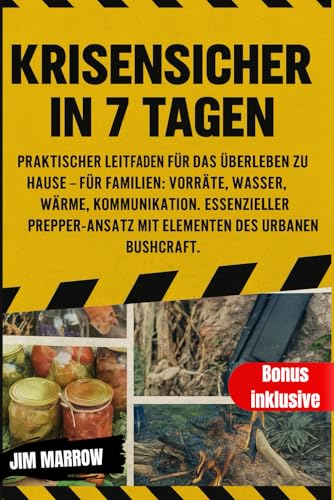
Checklist: Basic questions for your crisis plan
- Where is the nearest safe meeting place if the home becomes uninhabitable?
- How do I get there - on foot, by car, by bike?
- Which telephone numbers should be written down?
- Who will be informed when I leave?
- What documents do I need to bring (ID, insurance, proof of ownership)?
- Do I have an emergency backpack to hand?
Checklist: Supplies for at least 10 days
- Drinking water: 2 liters per person per day
- Shelf-stable food (canned goods, dry goods)
- Cooking facilities (camping stove + fuel)
- First aid material
- Hygiene articles
- Clothing for all weather conditions
- Flashlights, batteries, emergency radio
These lists are not a law, but a basis. Add what suits you.
Table: Scenarios and measures
| Scenario | Immediate action | Long-term strategy |
| Power failure | Activate light sources, unplug devices | Use supplies, seal rooms, check heating options |
| Evacuation | Grab your go-bag and head for the meeting point | Secure alternative accommodation, inform contacts |
| Flood | Leave the cellar, turn off the power | Store important documents on high, keep supplies dry |
| Supply crisis | Ration supplies | Use neighborhood networks, look for alternative sources |
Such tables help you to react quickly without thinking.
Communication - the underestimated element
In crises, it is amazing how quickly information dries up. Cell phone networks collapse, the Internet stops working, even the radio sometimes goes silent. Then what counts is what you have prepared.
- Note down emergency numbers - not in the cell phone, but on paper.
- Agree family code - a short signal word that everyone understands.
- Set meeting points - so that nobody runs into the void.
I remember the storm Kyrill in 2007: telephone lines were down, cell phone networks were overloaded. People were running from house to house to make sure their neighbors were okay. This is exactly where it becomes clear: communication is more than just technology, it is also a social network.
The emergency backpack - your mobile plan
A crisis plan is only as good as your ability to implement it. What if you suddenly have to get out? Then the Go-Bag - a rucksack with the essentials.
Contents of a Go-Bag (example):
- Copies of important documents
- Water filter or tablets
- Shelf-stable snacks
- First aid kit
- Flashlight + batteries
- Clothing, rain protection
- Cash in small denominations
- Map of the surroundings
- Charger (solar or crank)
This rucksack is like a key: it gives you the opportunity to remain capable of action.
Roles and responsibilities
When you are alone, you are responsible for yourself. It's different in a family or group. In this case, everyone should know what they have to do.
Example:
- One of them looks after the children.
- One secures documents and valuables.
- One of them checks the surroundings (turn off the gas, switch off the electricity).
A simple sentence can be worth its weight in gold in a crisis: „You do that.“

Rehearsals - the forgotten part
Many people write down plans and put them in a drawer. But a plan only lives if it is practiced. Don't make it complicated. Go through the process with your family: „What will we do if the power goes out tonight?“
That may feel strange at first. But believe me: when things get really serious, you'll be grateful that everyone knows the procedures.
Crisis plan as a personal project
A crisis plan is not a static document. It grows with you. Are you moving? Then meeting points change. Are you having children? Then priorities shift.
I have my plan in a simple folder - no great science. But the mere fact that it exists gives me peace of mind.
Conclusion
A crisis plan is more than just a collection of lists. It is a promise to yourself and your loved ones: that you are prepared, that you will be able to act when others lose their heads.
Nobody hopes for crises. But those who take them into account take away some of the horror. And sometimes that is the difference between panic and clarity.
So: start small. Write down your most important contacts, decide on a meeting point, pack a rucksack. Step by step, your personal crisis plan will grow from there. Not perfect, but practical.
Because in the end, it's not the plan itself that saves you - it's the fact that you have one.
 Deutsch
 English