

When was the last time you saw a child enthusiastically holding a piece of wood in their hand - not to play with it like a plastic toy, but to build something with it? Children have an innate urge to explore, an insatiable curiosity. And this is exactly where bushcraft comes in: practical skills combined with adventure, embedded in nature.
But bushcraft for children is not just „survival light“. It is an invitation to gain experience outdoors, to learn with all the senses and to develop self-confidence, creativity and mindfulness in the process.
Why bushcraft is so valuable for children
Modern childhood often takes place between walls - houses, schools, digital screens. There is nothing fundamentally wrong with this, but nature offers something that no tablet or textbook can replace: a direct experience.
- Self-confidence: A child who learns to light a small fire or build a shelter feels: „I can do something.“
- Creativity: Sticks, leaves, stones - suddenly everyday objects become tools and play materials.
- Ability to work in a team: Many bushcraft tasks are more fun in a team. Collecting wood together or setting up camp strengthens team spirit.
- Mindfulness: Those who move in nature learn to look, listen and feel.
And last but not least: Bushcraft is a form of safety. Children who learn to find their way around outside at an early age carry this knowledge with them for the rest of their lives.
Playful learning - the key
Unlike adults, children do not learn by sitting down at a textbook. They learn by trying things out, by failing, by repeating. Bushcraft offers ideal conditions for this because the environment itself is already full of puzzles.
Bushcraft for children can be seen as a kind of „adventure school“: Every task is a game, but every game imparts knowledge.
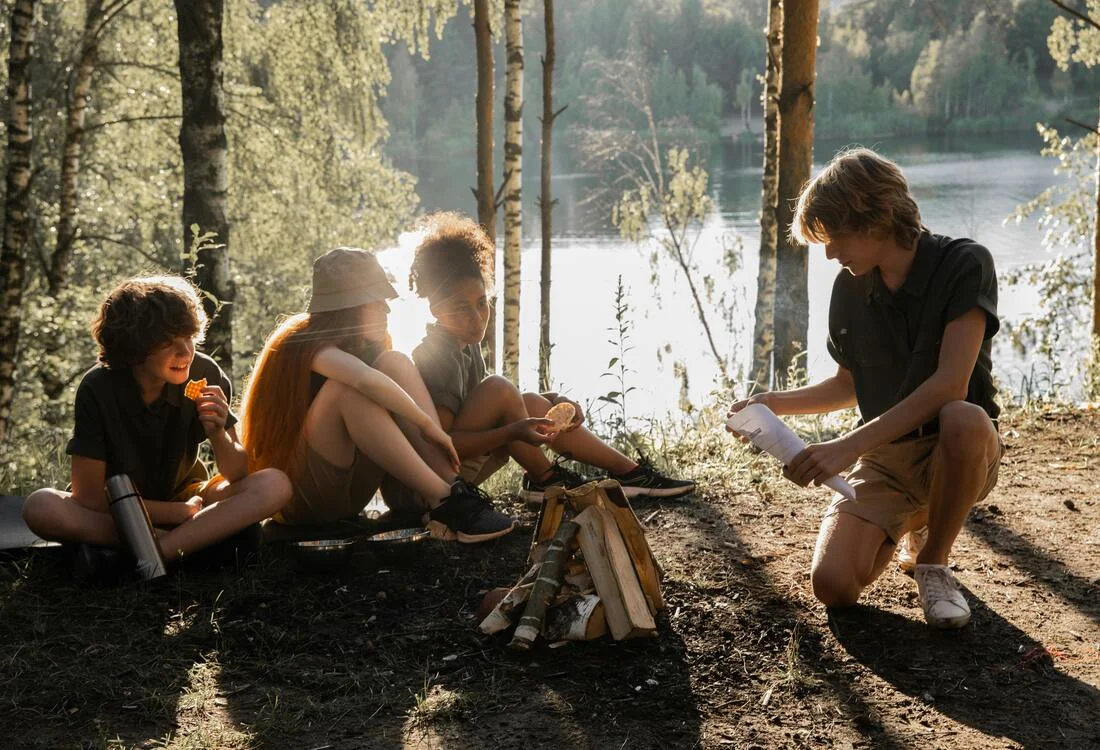
First steps - simple exercises for children
Here are a few practical ideas for introducing children to bushcraft in a fun way:
Understanding fire (without igniting immediately)
- Collect and compare types of wood.
- Build small tinder nests from dry grasses.
- Experimenting with spark steel - under supervision, of course.
Build a shelter
- Build a small „hut“ from branches.
- Seal with leaves and twigs.
- Ask the question: „What would keep you dry if it rained?“
Finding and filtering water (suitable for children)
- Think together: Where could water be collected?
- Build simple filters - e.g. using fabric or sand.
- This teaches children that clear water is not automatically clean water.
Explore plants
- Identify non-toxic, easily recognizable plants such as stinging nettle or dandelion.
- Make small „forest salads“ from leaves.
- Clear rule: „We only try what we have recognized together.“
Nature as a playground - but with rules
Children need freedom, but also clear boundaries. Bushcraft does not mean that everything is allowed. Safety comes first.

Basic rules for bushcraft with children
- Never alone. Adults should always be present.
- Tools with care. Knives or fire steel only under supervision.
- Respect for nature. No unnecessary destruction, no pointless felling.
- Increase slowly. First simple tasks, then more complex ones.
These rules are not there to put the brakes on fun, but to build trust.
Children and tools - a sensitive topic
Many parents hesitate when it comes to putting a knife in their children's hands. Understandable - and yet this is a valuable learning step. With the right guidance, children learn to see tools not as toys, but as aids.
- Just get started: A small pocket knife, blunt start.
- Sitting position: Children carve sitting down, at a distance from the body.
- Clear tasks: Don't carve randomly, but sharpen a stick to grill bread, for example.
- Convey respect: „A knife is not a toy, it's your helper.“
It is fascinating to observe how seriously children take a task when they feel that they are being trusted.
Small adventures, big impact
Bushcraft for children doesn't have to be a tour lasting several days. An afternoon in the forest is enough to awaken a sense of adventure.
- A treasure hunt in which the clues are made from natural materials.
- A „survival game“ in which the children have to build a camp before it gets „dark“ (the clock is ticking).
- A night hike with the aim of consciously perceiving the sounds of nature.
Such experiences are memorable - much more so than dry explanations.
Table: Playful bushcraft ideas for children
| Activity | Learning objective | Age group (approx.) |
| Collecting firewood | Recognize differences in material | from 5 years |
| Building a leaf hut | Teamwork, creativity | from 6 years |
| Knot games | Fine motor skills, patience | from 7 years |
| Identify plants | Mindfulness, nature study | from 8 years |
| Orientation with the sun | Understanding cardinal points | from 9 years |
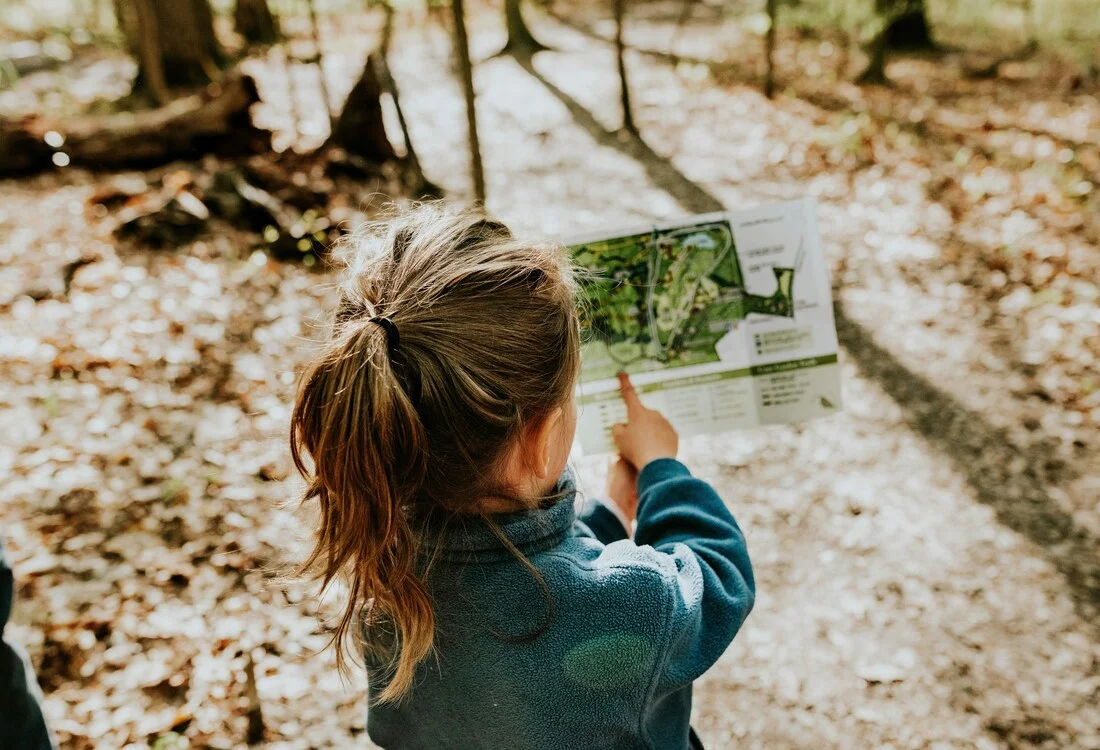
Mindfulness and responsibility
An important aspect that can be taught to children through play is respect for nature. Bushcraft is not just about „learning to survive“, but also about living in harmony.
- Extinguish fires. Children learn that you are responsible even when you leave.
- To leave traces or not? Discuss whether you can build your camp in such a way that it disappears again.
- Observe animals, do not disturb them. Sit still and see who shows up.
It is precisely this part that makes bushcraft so valuable - it not only teaches technique, but also attitude.
When children ask questions
Children have a talent for questioning the seemingly simplest things. „Why can I eat this leaf but not that one?“ „Why do we need a fire at all?“ „Why can't we just lie down when it rains?“

These questions are worth their weight in gold. They open up conversations that go far beyond bushcraft. They lead to topics such as responsibility, safety and the natural cycle. Those who take such moments seriously not only give children knowledge, but also the feeling that their curiosity counts.
Personal touch
I remember an afternoon with a group of children when we did a little „survival challenge“. The task was to build a shelter that could accommodate everyone. It was chaos at first. Everyone wanted to build something different. But after half an hour, they started to coordinate, sort materials and assign tasks. In the end, they had an amazingly sturdy hut made of branches and leaves.
The pride on their faces was priceless. No one had asked: „Do we have to do this?“ They had simply noticed: We can do that.
List: Important learning effects for children
- Problem-solving skills: How do I build something from what I find?
- Self-employment: Making decisions, taking responsibility.
- Patience: Not everything works straight away - and that's okay.
- Body awareness: Balancing, climbing, carrying - everything trains motor skills.
- Security awareness: Recognize and adhere to boundaries.
Conclusion: an adventure that lasts
Bushcraft for children is far more than just „outdoor play“. It's a way to promote self-confidence, respect and creativity - while playfully teaching skills that can be useful in a real emergency.
The great thing about it is that you don't need a big budget or high-tech equipment. Sticks, stones, leaves - nature provides the material. What counts is the company, the example and the shared experience.
What remains at the end is not just the knowledge of how to light a fire or build a hut. What remains is the memory: of crackling leaves, of cold hands that nevertheless continue to work, of the feeling of having completed a small adventure.
And perhaps when these children grow up, they will remember exactly these moments - and feel that they can find their way even in difficult times.
 Deutsch
 English