

A sudden power cut. Gas pipes shut down. No camping stove within reach. What then?
If you need hot food or hot water in such a situation, an emergency cooking station made from natural materials is more than just a gimmick. It is a piece of independence - and a decisive factor for survival in an emergency.
Perhaps you remember your childhood when you built small fires in the forest that were little more than a pile of burning twigs. Back then, that was enough to roast a half-black, half-raw stick bread. Today, in the context of serious crisis preparedness, we think in a more structured way: how can we use what nature provides to build a cooking area that works reliably?
Why emergency cooking stations are so important
Food fulfills several tasks in times of crisis: It provides you with energy, gives you warmth and has an enormous psychological effect. The smell of cooked soup, the crackling of the fire, the first spoonful of hot broth - all this provides support in uncertain moments.
But without cooking facilities, you quickly run into problems:
- Dry food remains tough or indigestible.
- Water cannot be boiled to sterilize it.
- Baby food or medicinal herbal extracts are not to be produced.
An emergency cooking station replaces more than just the stove - it is the basis of your self-sufficiency.
Basic principles of construction
Before we get to the different variants, a few basic rules:
- Safety first. Build the cooking area on a non-combustible surface - earth, sand or stone.
- Using the wind - but in a controlled manner. Air supply is crucial for a good fire.
- Note stability. Your pot or pan should not tip over.
- Adjust fuel. Hardwood glows for a long time, softwood burns quickly and hot.
With these basics in mind, you are already much better prepared than someone who simply lights a few sticks.
Different types of emergency cooking stations
There is no one right construction method. Depending on the environment, materials and time, you can use different methods.
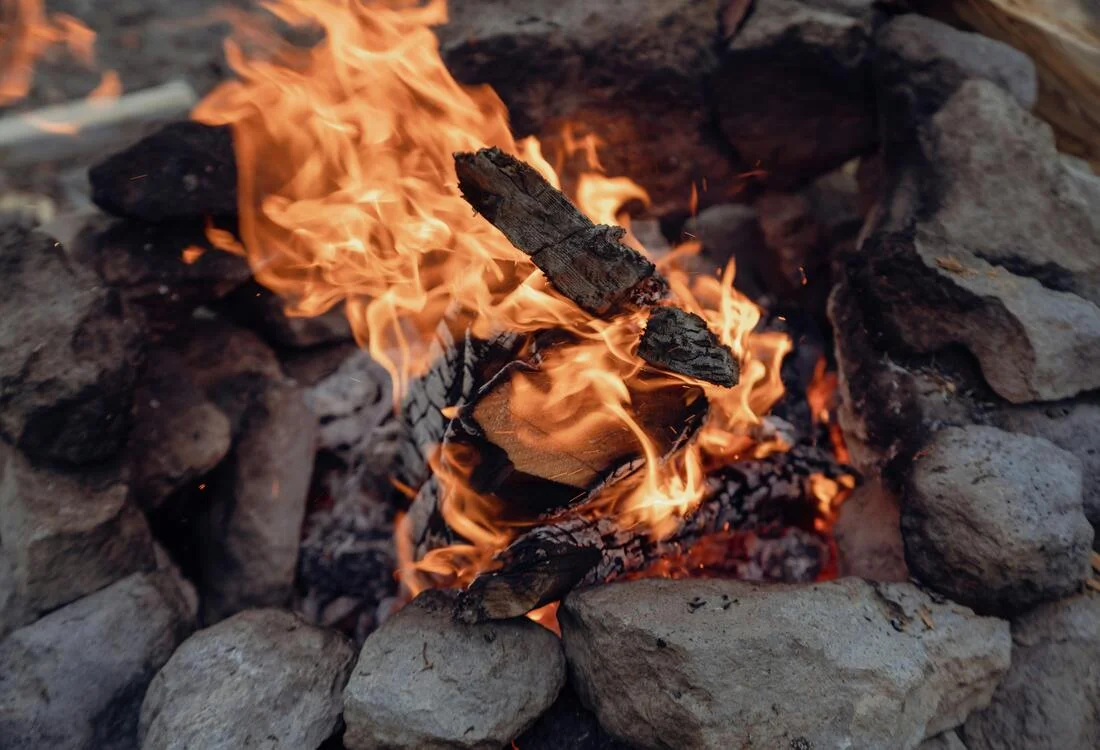
1. the classic fireplace with stone circle
This is probably the oldest form. You dig a shallow hole in the ground, surround it with stones and place the fire in it.
- Advantage: Simple, quick, feasible almost anywhere.
- Disadvantage: Heat loss, not protected from the wind.
- Tip: The stones store heat - you can warm yourself on them after cooking.
2. the three-legged hob
Three sturdy branches, tied together at the top, form a framework. Hang a pot or kettle from it into the fire.
- Advantage: Sturdy, also suitable for heavy containers.
- Disadvantage: You need rope, wire or roots to connect them.
- Tip: The heat can be regulated with a height-adjustable chain.
3. the star stove („star fire“)
Several thick logs are placed in the fire in a star shape. They are added as they burn down. The pot is placed directly on the center.

- Advantage: Very efficient, good flame bed.
- Disadvantage: Pot may be unstable.
- Tip: It is safer with three stones as a support.
4 The Dakota stove
One of the best variants for camouflage and efficiency. Two holes in the ground: one for fire, one for air supply, connected by a tunnel.
- Advantage: Hardly any smoke, protected from the wind, economical wood consumption.
- Disadvantage: Needs more time to build.
- Tip: Ideal if you need to remain inconspicuous.
5. cooking area made of clay or earth
If you are in one place for a longer period of time, it is worth building a small oven structure. Earth or clay can be shaped and hardened by the fire.
- Advantage: Retains heat, reduces wood consumption.
- Disadvantage: Construction time, not mobile.
- Tip: A stove with a chimney flue improves the air supply enormously.
List: Natural materials for an emergency cooking station
- Stones: as a boundary, heat accumulator, carpet pad.
- Branches & trunks: Scaffolding, fuel, supports.
- Clay & Earth: for sealing and building oven structures.
- Grass & foliage: as a lighter.
- Sand: for stabilizing and extinguishing.
Collect & prepare fuel
No hob without fuel. But not all wood is equally suitable.
Quickly combustible (lighter)
- Birch bark (also burns when damp)
- Resin pieces from pine trees
- Dry grasses and thin twigs
Permanently glowing (ember bed)
- Oak
- Beech
- Ash
Rather avoid
- Coniferous woods on a large scale (lots of smoke, resin splashes).
- Freshly cut wood (contains too much water).

Table: Comparison of cooktops
| Type of hob | Expenditure | Efficiency | Suitable for |
| Stone circle | low | medium | Short meals |
| Tripod | medium | high | Longer cooking |
| Star oven | low | medium-high | Mobile use |
| Dakota stove | high | Very high | Camouflage, efficiency |
| Clay/earth oven | Very high | Very high | Longer locations |
Practical tips from experience
- Always have a deletion option to hand. A bucket of water or sand next to the hob can make all the difference.
- Improvise a pot holder. If necessary, a green forked branch can be used as a support.
- Note the wind direction. Don't stand so that the smoke hits your face - or worse: your tent.
- Preparation is everything. It's better to spend an extra 20 minutes collecting wood than to end up with half-raw noodles later.
Mistakes that happen frequently
- Fires too big. A smaller, controlled fire is often better for cooking.
- Wrong wood. Wet wood produces smoke and hardly any heat.
- Unstable cooking surface. Nothing is more frustrating than an overturned pot.
- Location incorrectly selected. There is a risk of fire under trees or in dry grass.
Personal memory
I remember a hike in the Harz Mountains where we were caught completely unexpectedly in a cold snap. We had food, but no cooking facilities. With a few stones, an improvised star fire arrangement and a lot of patience, we managed to get water hot for tea. That first sip, steaming and warming, was worth more at that moment than any luxurious meal. This shows just how fundamental such knowledge is.

Metaphor: A hob is like a heart
It may sound pathetic, but an emergency cooking station is like a heartbeat in camp. It concentrates energy, provides warmth, keeps you alive. Just as the heart moves the blood in your body, the fire moves the power back into you.
Conclusion: Practice before it gets serious
Building an emergency cooking station from natural materials sounds simple - and in principle it is. But in the stress of a crisis, small mistakes make all the difference. So practise now. Build yourself a small fire pit in the garden or on a hike. Experiment with different types of wood. Test how stable your improvised tripod really is.
This is the only way you won't have to improvise in an emergency must, but can take targeted action. And the feeling of sitting in the forest, listening to a pot of soup bubbling over a homemade hob, is an experience that is worth every bit of preparation.
 Deutsch
 English