

Imagine you've been on the road for days. Your rucksack is getting lighter, not because you have become stronger, but because your supplies are running low. You sense that you need food - and soon. In a real survival situation, the question quickly arises: „How could I possibly get anything to eat here?“ And then you almost automatically end up with an age-old topic: trapping.
But as appealing as it sounds - catching an animal with a cleverly constructed mechanism - it is legally a minefield. In Germany and most European countries, trapping is strictly regulated and usually even prohibited, unless you are a hunter with special training and a permit. Nevertheless, knowing how to trap is part of a prepper's toolbox. Not so that you can go into the forest with it today or tomorrow, but so that you can act in an absolutely exceptional case.
Trapping - an ancient craft
For thousands of years, people have used traps to procure food. Whether pits, snares or ingenious constructions made of wood - traps were often more effective than hunting with bow and arrow. While the hunter had to follow a deer for hours, the trap could stand still in the forest and prove its patience.
The principle is simple: the trap works for you. It is an extended arm, a silent hunter that needs neither sleep nor breaks. But it is precisely this efficiency that explains why it is strictly regulated today.
Legal aspects: What is allowed, what is not?
Before we even talk about technology, it must be clear: In Germany (and similarly in Austria or Switzerland), as a private individual you are allowed to Do not set traps to catch or kill wild animals.
Why?
- Traps can be cruel if they are not built properly.
- They endanger not only animals, but also people and pets.
- They have a massive impact on the wildlife population.
So what applies?
- Only trained hunters with the appropriate qualifications are allowed to use certain traps - and only under clear legal conditions.
- Live traps that catch the animal unharmed may be permitted in exceptional cases (e.g. to catch a domestic cat or a marten).
- Killing by trapping is illegal for private individuals.
Exception: An absolute emergency
In a real survival scenario - far away from civilization, without help - different standards apply. Human survival takes priority. Here, trapping can be a decisive factor. However, this is a hypothetical, extreme situation. Anyone who builds and uses traps in normal everyday life is liable to prosecution.
Why it is still worth preserving knowledge
Couldn't you just say: „Then I'd better leave the topic altogether?“
No. Because knowledge in itself is not forbidden. Trapping to Learn, within a controlled framework practice (e.g. without actively placing them or with harmless dummies) is permitted - and makes sense.

Why?
- Survival training: In an absolute emergency, this knowledge can save lives.
- Craftsmanship: Building traps trains the eye for materials and mechanics.
- Understanding of nature: Those who understand traps also learn to read tracks, animal behavior and terrain assessment.

Technical basics of trap construction
There are hundreds of variations, from simple snares to sophisticated tilt traps. But the basic principles can be broken down into just a few points:
- Trigger - What causes the trap to slam shut? (e.g., a stick that is under tension)
- Energy source - Where does the force come from? (Gravity, tensioned branches, weight, water flow)
- Catch mechanism - How is the animal held or killed? (snare, crate, shackle)
- Lure or guide - How is the animal lured into the trap?
List: Typical types of traps (theoretically!)
- Snare traps - a wire or cord tightens as soon as the animal runs through it.
- Pitfalls - dug holes, covered with twigs or leaves.
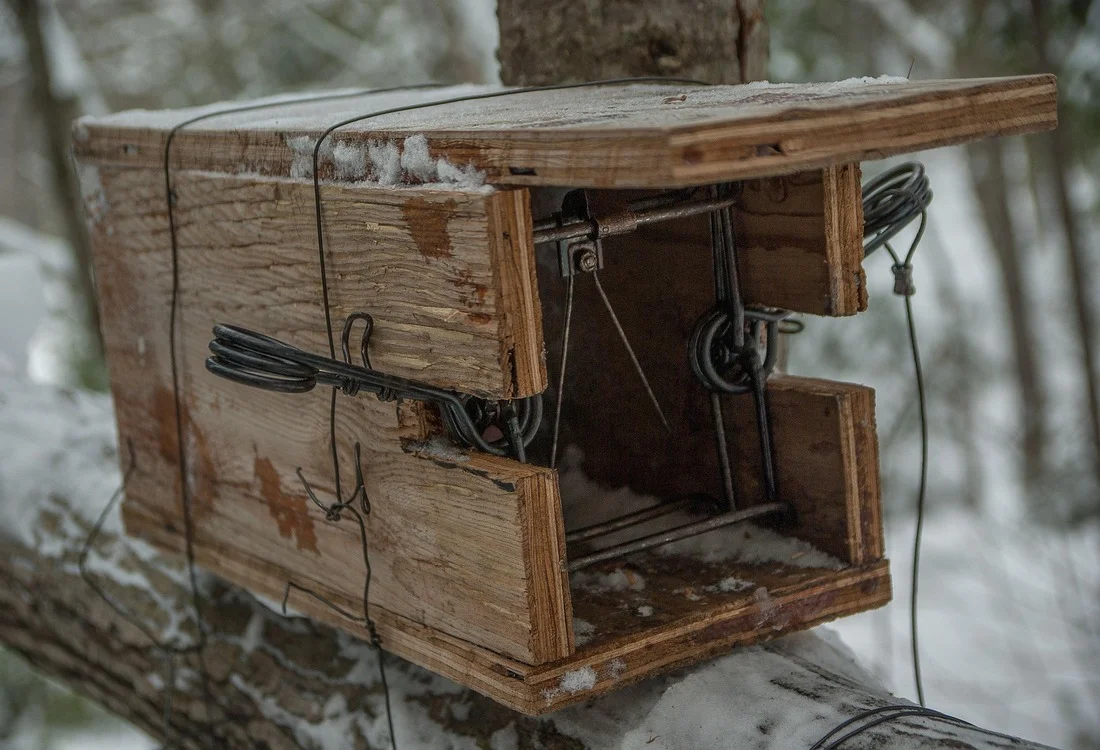
- Box traps - Animals run in, flap closes.
- Snap traps - a heavy object hits or falls on the animal.
- Rocking or tilting traps - a weight tilts when the animal touches the bait.
Table: Comparison of different trap principles
| Trap type | Mechanism | Typical application | Remark |
| Sling | Traction, rope pulls tight | Small game (rabbits) | Strictly prohibited in Germany |
| Drop pit | Animal falls into | Larger animals | Only conceivable in Survival |
| Box trap | The door snaps shut | Live trapping (martens, cats) | Legally possible with permission |
| Impact trap | Weight drops / hits | Mice, rats | Partially permitted for domestic use |
| Rocking trap | Tilts due to weight | Small animals, birds | For training purposes only |
Practicing trapping as a skill—but is it legal?
How can you practice trapping without coming into conflict with the law?
- Working with dummies. Build the mechanics, but leave the shutter release unfocused.
- Leave out the bait. This will prevent you from attracting animals.
- Focus on mechanics. Practice the technique - not the catching.
- Indoor training. Small models can even be made at home (e.g., mini tilt traps made from toothpicks).
What you take away from building traps
Even if you never set a trap, you'll learn a lot in the process:
- Patience and precision.
- The value of simple materials such as string, wood or stone.
- A feeling for balance, tension and trigger mechanisms.
It's a bit like chess: you not only learn to move the pieces, but also to think in terms of systems.
Common mistakes
- Unsuitable location. A trap in the middle of an open area is ineffective. Animals follow set routes—small paths that you have to learn to recognize.
- Wrong scale. A snare that is too large won't catch a rabbit; one that is too small won't catch a bird.
- Unclean building. Animals immediately sense unnatural patterns.
Personal touch
I remember a survival training course in Sweden. We built traps - but never set them, of course. The fascinating thing was how close you got to the animals. Suddenly you noticed trails in the undergrowth, traces of droppings, nibbled bark. Without the idea of trapping, I would never have noticed it so consciously. For me, that was the biggest gain: learning to read nature.
Metaphor: Traps as a mirror of civilization
A trap is like a small play. The trigger is the stage, the bait is the invitation, and when the curtain falls, everything is decided in a second. It shows us how much we humans have learned to use nature not just with strength, but with understanding. But that is also where the responsibility lies.
Conclusion: Knowledge yes - use only in an emergency
Trapping is a double-edged sword.
- In everyday life: Keep your hands off it. It's illegal and dangerous.
- As knowledge: Keep it, practice it in a controlled way, understand the mechanics.
- In an emergency: Then it can be the ability that makes the difference.
Because in the end, it's not just about technology or the law, but about an attitude: being prepared without carelessly overstepping the boundaries of the law or ethics.
 Deutsch
 English