

In hardly any other country in the world is the movement of the so-called Prepper as deeply rooted as in the United States. While in Europe the word „prepper“ has often only become known since the 2010s, the phenomenon has long been part of a broad social subculture in the USA - between survivalism, patriotism and a deep skepticism towards state control. But how did this movement come about? What are its cultural and historical roots? And why is the American mentality in particular the ideal breeding ground for such a pronounced self-sufficiency culture?
The origins: between pioneering spirit and the Cold War
To understand today's prepper phenomenon, you have to look back into the history of the United States. The idea of preparing for crises and surviving independently of the state is closely linked to the history of America's founding.
The early settlers and pioneers who headed west in the 18th and 19th centuries had to bring everything they needed to survive in the wilderness - tools, seeds, weapons and courage. These generations literally lived by their own skill and trust in their own hands. The state was far away, neighbors scarce, and help often unattainable. The thought, „I take care of myself“, was not a lifestyle, but a necessity.
The framework conditions changed in the 20th century - but the mentality remained. Particularly in the 1950s and 1960s, during the Cold War, the topic of Self-protection and Crisis prevention new topicality. The threat of nuclear war with the Soviet Union made many Americans think about civil defense. The government itself called for stockpiling and published brochures on how to survive in the event of a nuclear attack.
The Construction of private nuclear bunkers became a symbol of this era. Families hoarded tins, water canisters and Geiger counters. Companies sold kits for underground shelters, while pop culture picked up on the theme in movies and comics. Modern survivalism—and thus the intellectual foundation of the later prepper movement—was born.
The 1970s and 1980s: Economic Crises and Mistrust
In the 1970s, the movement's focus shifted. Following the end of the Vietnam War, the 1973 oil crisis, and the loss of trust in the U.S. government (keyword Watergate), many Americans began to view the government as increasingly unreliable.
The idea that the state could fail in the event of a crisis became a fundamental conviction. Books like „Patriots“ by James Wesley Rawles or „How to Survive the End of the World as We Know It“ created an entire genre: the Survival Literature.
James Wesley Rawles
James Wesley Rawles is considered one of the most influential authors in the American prepper community. His novels, such as „Patriots“ and „Survivors,“ have influenced entire generations—a blend of survival guide, political vision, and end-times scenario. Rawles is often referred to as the mastermind behind modern „Prepping 2.0.“.
These authors combined practical instructions—for example, on water treatment, weapon maintenance, or stockpiling—with an ideological message: only those who are prepared will remain free. The rest become dependent on government aid, which was seen as slow, inefficient, or even dangerous.
This was also the time when the first Prepper communities. People met at trade fairs, exchanged tips via radio stations or later on the early Internet (BBS forums). Topics such as Self-sufficiency, energy self-sufficiency, gun ownership, and escape strategies were the focus.
Religion, freedom and weapons - the ideological DNA of the movement
American prepper culture is more than just a collection of practical tips. It is deeply ideological - shaped by three pillars of US society: Christian values, freedom of thought and gun ownership.
Many American preppers see themselves as followers of biblical figures such as Noah, who built the ark before the flood. The motif of divinely inspired preparedness runs through many blogs, YouTube channels and books. Especially in the southern states, the „Faith-based Prepping“ widespread: Stockpiling is understood here not only as a practical but also as a moral duty.
Added to this is the deeply rooted mistrust of state authority. The USA was born out of a revolution against a centralized power - this ideal of freedom still shapes the thinking of many citizens today. In this logic, state aid in the event of a disaster is not perceived as security, but as a threat to individual freedom.
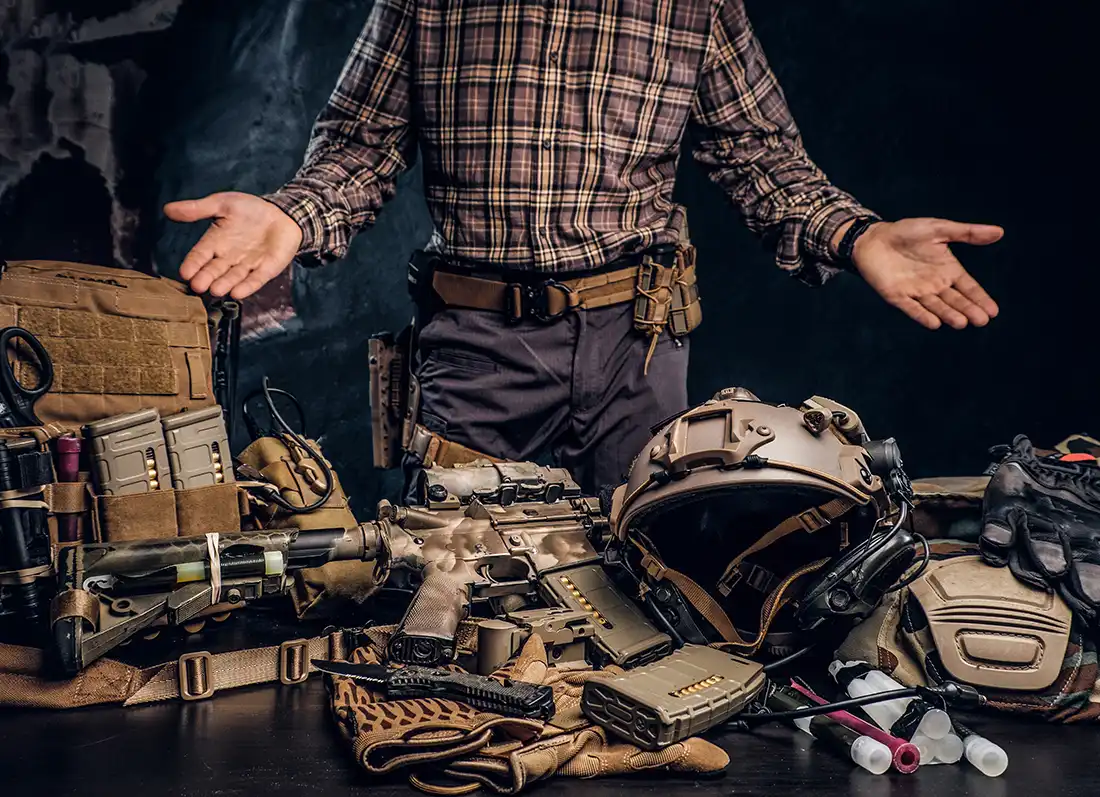
And finally, the Gun culture a central role. The right to bear arms, enshrined in the Second Amendment, is viewed by many preppers as the last line of defense—not only against criminals, but also against possible attacks by the government in times of crisis.
The movement is thus merging with other milieus: militias, libertarian groups and Christian fundamentalist circles. The result is a colorful but ideologically tense scene, ranging from harmless self-supporters to paramilitary organized groups.
9/11 and „Prepping 2.0“ - The return of fear
After a calmer phase in the 1990s (characterized by an economic upswing and technological optimism), September 11, 2001 came - and with it a new era of uncertainty.
The terrorist attacks on the World Trade Center shook Americans' sense of security to the core. Suddenly it was clear that danger was not only coming from outside, but could strike in the midst of everyday life. The state seemed powerless against unforeseeable events.
This period marks the beginning of what many call „Prepping 2.0“ to describe it. Now it was no longer just about nuclear or economic disasters, but about terrorist attacks, cyber wars, pandemics, and social collapse.
The internet also facilitated extensive networking: forums, blogs, and later YouTube channels such as „The Survival Podcast“ and „Canadian Prepper“ made the topic accessible to a wide audience. The term „prepper“ became socially acceptable—albeit with a touch of eccentricity.
The media picked up on the topic. Reality TV shows such as „Doomsday Preppers“ (National Geographic, from 2011) showed American families preparing for the end of the world—from self-built bunkers to underground farms. Although the series relied on clichés, it played a decisive role in making the topic of prepping known worldwide.
Doomsday Preppers
The reality TV series „Doomsday Preppers“ (2011-2014) made the topic of crisis preparedness known worldwide. The programme showed extreme cases, but also led to a broad audience thinking about emergency supplies, self-sufficiency and crisis management for the first time - a decisive moment for the popularization of the prepper movement.

Crises as fuel: from the financial crisis to the pandemic
Every crisis in recent decades has given new impetus to the prepper movement:
- 2008: The global financial crisis shook confidence in banks and governments. Many began to hoard gold, hold cash reserves or invest in land and real assets.
- 2012: The fear of the „Mayan calendar“ doomsday caused a veritable boom in survival products and emergency supplies.
- 2016-2020: The political division in the USA under Donald Trump, the unrest surrounding Black Lives Matter and discussions about „fake news“ reinforced the perception of a fragile society.
- 2020-2021: The COVID-19 pandemic was ultimately the turning point. Suddenly, millions of people experienced what empty supermarket shelves and supply chain problems meant. What used to be ridiculed suddenly seemed sensible: supplies, emergency generators, masks, disinfectants.
While many new preppers began to prepare themselves during the pandemic for pragmatic reasons, the long-standing scene representatives saw this as confirmation of their world view: the state is not prepared - so you have to be.
The Market for Fear: Prepping as a Business
Where there is fear and uncertainty, markets emerge. In the USA, an industry worth billions has developed around the topic of prepping.
Companies sell everything from freeze-dried meals to solar-powered generators and bulletproof backpacks. Brands such as My Patriot Supply, Augason Farms or ReadyWise are now firmly established in American online retail.
My Patriot Supply
My Patriot Supply is one of the largest suppliers of emergency food in the United States. The company is representative of a multibillion-dollar industry that capitalizes on fears of crises—with freeze-dried meals, water filters, and complete „72-hour kits“ for emergencies.
Large retailers such as Walmart and Costco also offer emergency kits that promise weeks of self-sufficient living. The internet is full of affiliate links, product reviews, and discount codes for bug-out bags, water filters, and tactical gear.
However, commercialization has also changed the landscape. Many traditional preppers criticize the fact that the original idea— self-reliance and sustainability—has increasingly become a lifestyle. „Prepping light“ for city dwellers—with designer backpacks and premium canned goods—often replaces the original philosophy of simplicity and self-sufficiency.
Modern Preppers: Between Sustainability and High-Tech
Today, the American prepper movement is more diverse than ever. In addition to the classic survivalists, there are new trends that interpret the topic more broadly:
- Urban Prepping: People in cities who learn how to store supplies in small spaces or use alternative energy sources.
- Green Prepping: Ecologically minded self-sufficient people who rely on sustainability and permaculture rather than arsenals.
- Tech Prepper: Digital natives who deal with topics such as solar energy, satellite communication or self-sufficient data networks.
Communication has also changed. Platforms such as Reddit, Telegram, and YouTube have become central gathering places. Influencers offer tips on crisis management, first aid, and long-term nutrition. The focus is increasingly shifting away from mere „survival“ toward Resilience - in other words, the ability to survive crises and emerge stronger.
Criticism and Misunderstandings
Prepping is often portrayed in the media as a paranoid hobby. Images of men in camouflage clothing, carrying assault rifles, and harboring apocalyptic fantasies epitomize this cliché. In fact, there are extreme groups in the U.S. that exploit the topic for political gain or associate it with conspiracy theories.
But that doesn't quite capture the picture. Many preppers are neither conspiracy theorists nor extremists, but simply people with a strong sense of responsibility. In a country where tornadoes, forest fires, and snowstorms regularly bring entire regions to a standstill, it is important to be prepared. Crisis prevention is simply common sense.
The movement itself is struggling to maintain its image: numerous blogs and podcasts are trying to portray prepping as a Practical Philosophy of Life not as a culture of fear.
„Prepare for the worst, hope for the best“ is an often quoted motto. So it's not about panic, but about calmness through preparation.
Why the U.S. Remains the Home of Preppers
More than any other country, the United States embodies the combination of freedom, risk, and uncertainty that has given rise to the prepper movement. The mix of geographical diversity, Natural disasters, political division, Gun culture and Pioneering spirit creates a unique environment.
Prepping is no longer a fringe phenomenon there, but part of everyday culture. Whether it's hurricane preparedness in Florida, earthquake planning in California, or snowstorm resilience in the north—millions of Americans have learned that self-sufficiency is not a luxury, but a necessity.
The movement continues to evolve: away from end-times thinking, toward practical crisis resilience. Modern preppers combine high-tech solutions with traditional skills—from solar panels to vegetable gardens.
And so, despite all the contradictions, the United States remains the birthplace of a movement that has long since gained followers around the world—including in Germany.
Conclusion: Between Freedom and Fear
The American prepper movement is a reflection of a society that vacillates between trust and mistrust - between a belief in progress and doomsday scenarios. It is rooted in a culture that elevates independence to a virtue and transforms fear into action.
Whether you see prepping as an expression of fear or as a form of modern self-determination depends on your perspective. One thing is certain: In a world that is becoming increasingly complex and unpredictable, the old American idea of „self-reliance“ is finding new relevance.
The USA invented prepping - and perhaps this phenomenon in particular shows that freedom and preparedness are two sides of the same coin.
 Deutsch
 English