

Imagine you are sitting in the forest, accompanied only by the crackling of a small fire. No street noise, no screen, no obligations. Just you, your hands and the tools that nature offers you. Sounds romantic? Perhaps. But bushcraft is more than just a nice break: it's a craft, an attitude, sometimes even a small test of your own resilience. And as with any craft, it's the beginning that decides whether you stick with it or give up in frustration.
The most important tips
But where do you start? Which skills are really important for beginners - and which can be learned later? That's exactly what this article is about: 10 bushcraft tips that will make it easier for you to get started and quickly make you feel how fulfilling it can be to get along outdoors.
Tip 1: Start small
Many beginners make the mistake of wanting to conquer „the great wilderness“ straight away. Tours lasting several days, complicated equipment, experiments with fire-drilling in the rain. This often ends in frustration.
Start with simple steps: a night in the garden, a day in the nearby forest. Learn to use your knife, make a small fire, build an improvised shelter. Bushcraft grows from small successes, not heroic deeds.
Tip 2: Know your knife - and treat it with respect
The knife is to bushcraft what a paintbrush is to a painter: a tool, an extension of the hand, sometimes even life insurance.
- Choose a robust knife with a fixed blade.
- Learn the basic techniques: carving, splitting (batoning), making feather sticks.
- Keep it sharp and clean.
A blunt knife is more dangerous than a sharp one - because you have to use more force. If you understand your knife, you gain safety and precision.
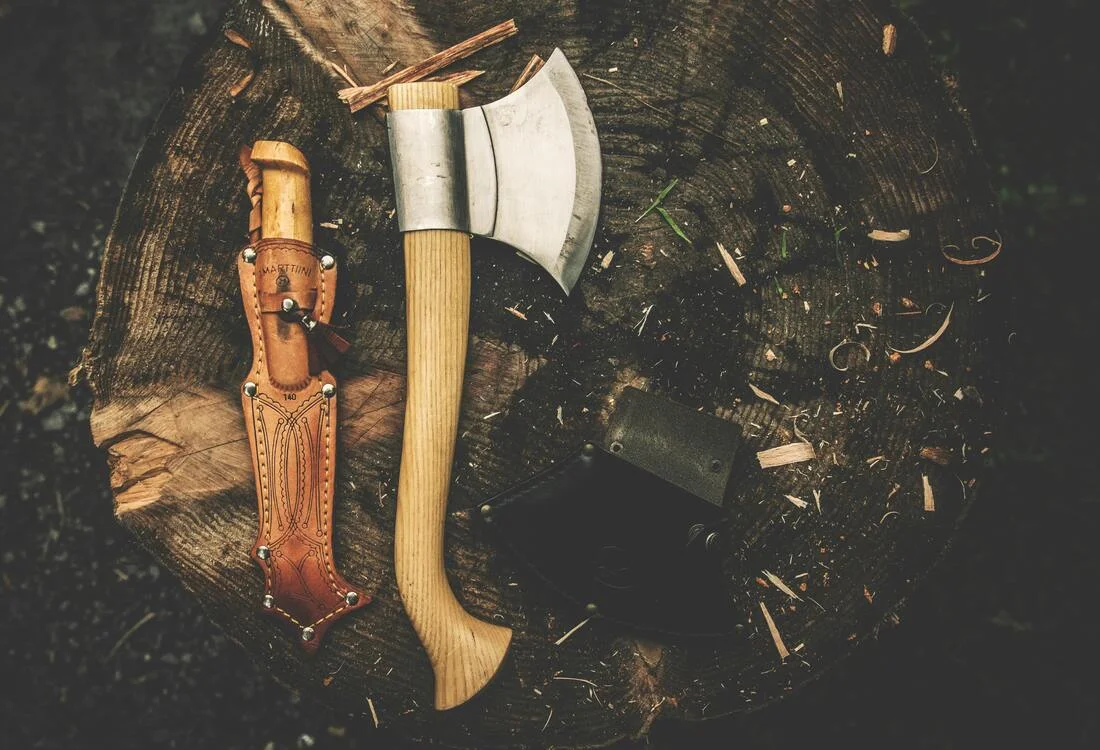
Tip 3: Make a fire - but the right way
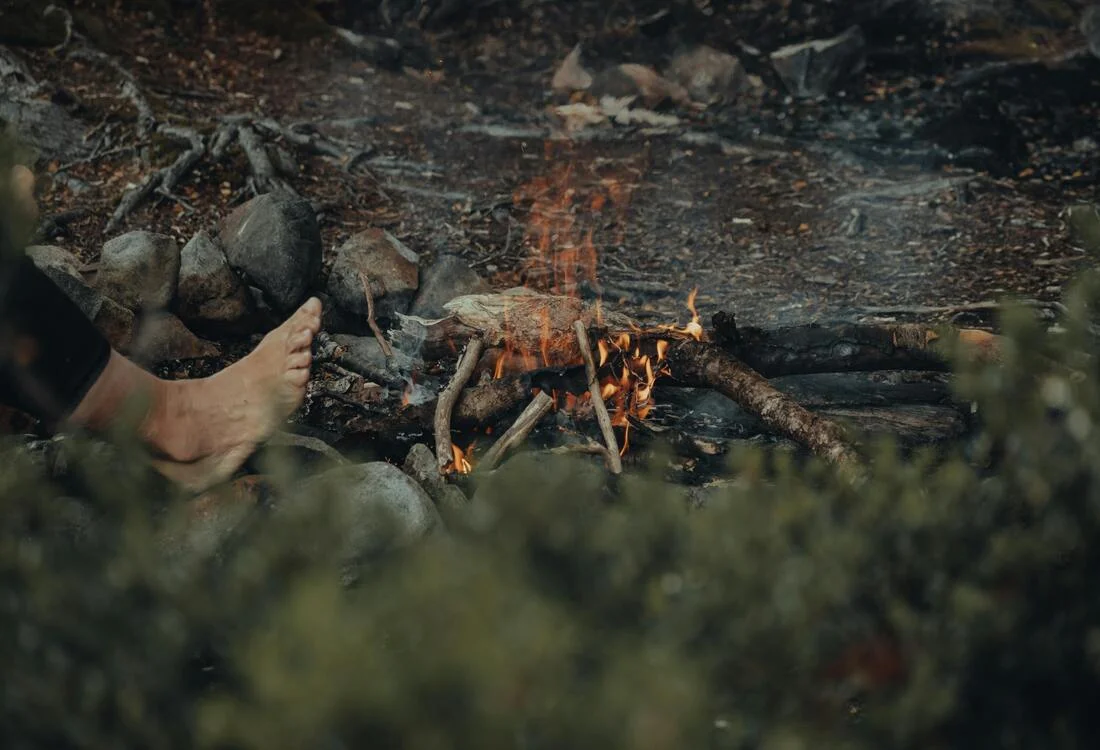
Nothing gives more security than a fire. Warmth, light, a place to cook, protection. But fire is also the thing that most often causes beginners to fail.
Practice different methods: Fire steel, matches, lighter. And even more important: learn to find tinder or make it yourself. Birch bark, dry grass, pine shavings - all of these are worth their weight in gold.
A simple exercise: try to collect a handful of potential tinder every time you go for a walk. This will help you train your eyes and be prepared in an emergency.
Tip 4: Build a roof over your head
You don't have to perform an architectural miracle. A tarpaulin (tarp) between two trees is often enough to provide protection from rain and wind.
For beginners, it's better to be simple and stable than complicated and beautiful. A diagonally tensioned tarp that keeps the wind out can save the night.

In an emergency, a leaf shelter will also work. But you should practise a little, because nature does not forgive poor construction methods.
Tip 5: Layer by layer - the right clothing
Bushcraft means being outdoors. And outside means: weather. Nothing is as grueling as the cold slowly creeping into your body.
The basic rule: Shift system.
- Bottom layer: wick away moisture (merino wool or synthetic, never cotton).
- Middle layer: store heat (fleece or wool).
- Outer layer: keep out wind and rain (jacket, poncho, tarp).
Anyone who has ever experienced this understands that clothing is not fashion, but equipment.
Tip 6: Learn the language of trees
Trees are more than just suppliers of wood. They provide information about water, weather and food.
- Birch: tinder (bark), sap in spring, wood for fires.
- Spruce/fir: resin (perfect tinder), branches for soft underlays.
- Oak/beech: Acorns and beechnuts - edible if prepared correctly.
An easy way to get started: make a resolution every time you go out, one really get to know the tree - with its leaves, bark and benefits. Your knowledge will grow bit by bit.
Tip 7: Water is life
No life without water. A river or stream in the forest looks romantic, but it is rarely drinkable.
Basic rules:
- Always boil water if possible.
- Portable filters are useful, even small models.
- Condensation or dew can also be used - not much, but crucial in an emergency.
A simple exercise: build a solar still in the garden (a sheet, a container, some soil). Not because it provides large quantities, but because it sharpens your understanding of water sources.
Tip 8: Knotology
A rope is worthless if you can't control it. With the right knots, you can build shelters, secure loads and set traps.
Three knots are sufficient for beginners:
- Bowline fixed loop,
- Carpenter's knot (adjustable loop),
- Square knot tie two ropes together.
Practice these knots in everyday life: when hanging up laundry, fastening things in the car, doing handicrafts. This way they become a habit.
Tip 9: Keep calm - the invisible skill
Bushcraft is not just about technique, but also about attitude. If you panic, you make bad decisions.
A night in the forest can be frightening: Noises, darkness, uncertainty. The most important skill then is calmness. A small fire, a clear structure („first camp, then water, then fire“) - and the fear loses its power.
It sounds banal, but it's crucial: rest saves energy.
Tip 10: Remain traceless
Bushcraft thrives on respect for nature. You can recognize a true expert by the fact that he leaves no traces behind.
- No garbage, no carvings in trees.
- Keep fires small and extinguish them.
- Do not disturb animals.
A nice thought: Your best success is when nobody can see that you were there in the morning.
Brief overview: 10 tips at a glance
| Tip | Contents |
| 1 | Start small |
| 2 | Know knives |
| 3 | Light a fire |
| 4 | Simple shelter |
| 5 | Shift clothing |
| 6 | Get to know trees |
| 7 | Ensure water |
| 8 | Practicing knots |
| 9 | Keep calm |
| 10 | Remain traceless |
Personal experience
I remember my first bushcraft night. Everything was prepared - I thought. But when the rain started, I realized that the tarp was hanging too low and the water was dripping onto the middle of my sleeping mat. I hardly slept, but in the morning I knew more than after reading a hundred tips. Mistakes are teachers - and that is exactly what makes bushcraft so valuable.
Conclusion: A craft that is growing
Bushcraft is not a sprint, but a journey. Once you start, you'll realize that it's not just about fire, knives and knots. It's about feeling at home outdoors. Piece by piece, night by night.
The 10 tips here are not a recipe book, but an invitation. Try them out, combine them with your own experiences and you'll see: Nature responds. Sometimes strict, sometimes generous, but always honest.
And at some point you might really be sitting under a self-built shelter, hearing the fire crackling and thinking: Now I have arrived.
 Deutsch
 English