

There are few things that connect us humans as deeply as fire. For thousands of years, we have sat around it, warmed ourselves, cooked on it and felt safe when darkness approaches. And yet fire cannot be taken for granted in an emergency. Matches get wet, lighters break, batteries discharge. What remains is a tool that seems archaic and is incredibly reliable at the same time: the firesteel.
But how do you use it properly? Many people have held a firesteel in their hand, coaxed out a few sparks and then given up in frustration. The principle is simple - and at the same time it requires a little practice, patience and the right knack.
What is a firesteel actually?
The fire steel, also known as a ferrocerium rod, is not a piece of steel in the traditional sense. It consists of a special alloy of iron, cerium and other metals. If you pull it with a hard scraper - usually the striker supplied or the blade of a knife - tiny metal particles tear off. These ignite immediately in the air, glow and produce sparks of up to 3000 degrees Celsius.
It sounds like magic, but it's pure physics. These sparks are hot enough to ignite fine, dry material - if it is prepared.
Why a firesteel is so valuable
You might ask yourself: Why should I go to the trouble of making sparks when I can just buy a lighter? The answer lies in reliability.
- Weatherproof: A firesteel also works in rain or snow, even if it gets wet.
- Durable: Several thousand fires can be lit with a single stick.
- Robust: It has no moving parts that could break.
- Independent No gas, no batteries - only your technology counts.
In a survival or prepper context, it is more than just a backup. It is a piece of security that remains faithful for days and weeks.
The basics: What you need for a fire
A firesteel alone is not enough. Without the right ignition material, the sparks will fizzle out ineffectively. Fire lives from three elements: Heat, fuel, oxygen.
When making a fire with firesteel, the ignition material is the critical point. It must be easy to ignite so that the small sparks have any chance at all.

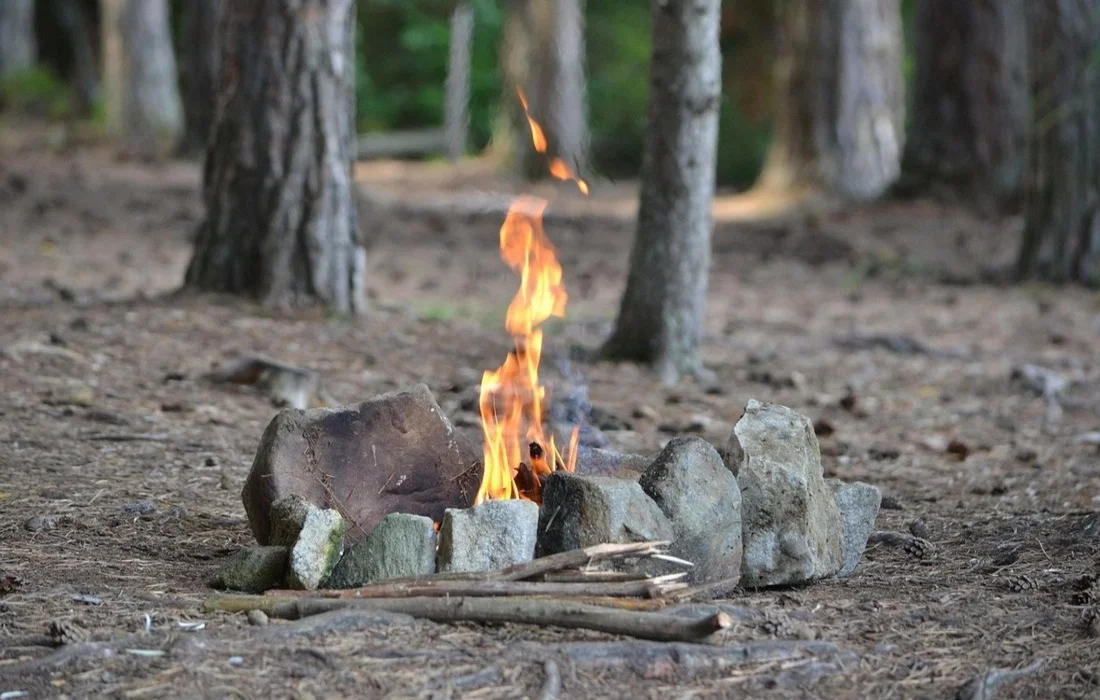
Examples of good scale material:
- Natural materials: dry grasses, birch bark, cattail wool, seed wool, dry lichens.
- Processed natural materials: Wood shavings roughened with a knife (so-called feather stick), resin splinters.
- Artificial aids: Absorbent cotton with Vaseline, tampons, cotton tinder, pine shavings.
Step by step: How to use the firesteel correctly
Here is a possible procedure that has proven itself in practice:
- Prepare the tinder. Gather your tinder material and place it so that the sparks can fall directly into it. It should be airy, but tight enough to allow heat to build up.
- Stack firewood. Even before the first spark flies, you should have thin branches, small twigs and finally thicker wood ready. Nothing is more frustrating than having a small ember that goes out due to a lack of fuel.
- Grasp the firesteel. Hold it firmly in your hand with the tip pointing towards the tinder.
- Apply the scraper. Place the striker (or the back of your knife) at an angle of about 45° at the top end of the stick.
- Scrape downwards with pressure. Pull the scraper down firmly to create sparks. Important: Do not move the scraper, but pull the rod itself backwards - this prevents the tinder from slipping.
- Direct sparks into the tinder. Repeat the process until a spark sticks and makes the tinder glow.
- Blow carefully. As soon as embers appear, lightly add oxygen until a small flame flares up.
- Build a fire. Now add the prepared kindling and let the fire grow.
Common mistakes and how to avoid them
Beginners in particular often encounter the same difficulties. A few typical examples:
- Incorrect scale material: Too damp or too coarse - the sparks fizzle out.
- Too much power: If you jerk the stick forward uncontrollably, you will scatter the tinder.
- Too far away: Sparks fall into the void instead of into the prepared pile.
- Impatience: Giving up after a few attempts is the biggest obstacle.
Overview: Fire steel vs. other methods
A small table illustrates the differences:
| Method | Advantages | Disadvantages |
| Lighter | fast, uncomplicated | Empty gas, sensitive in wet conditions |
| Matches | light, available everywhere | moisture-sensitive |
| Fire steel | Robust, many ignitions possible | requires practice |
| Arch drill | Independent of metal or chemistry | Very difficult to master |
Tips for advanced users
Once you have understood the basics, you can get creative with the firesteel.
- Sparks directly into the resin: Pine resin catches fire quickly and burns for a long time.
- Impregnate absorbent cotton or cotton: Treated with Vaseline or wax, the result is a perfect, water-repellent scale.
- Use metal edges: The blade of a knife often works better than the scraper provided - but be careful, the edge will become blunt.
Fire steel in training: practice makes all the difference
A firesteel is not a magic wand. If you only try it out in an emergency, you will be disappointed. It's better to practise in everyday life - when camping, on tour or even in the garden.
I remember one fall evening when the rain had been beating down on the leaves all day. Everything was wet, cold, heavy. It took me almost twenty attempts before a small spark caught in a birch bark. But when the flame finally flared up, it felt like I had won a small victory. That's the gist of it: fire with a firesteel means patience, frustration and then joy.
Practical checklist for your luggage
If you are out and about with the firesteel, it is worth having a small set to hand:
- Fire steel + scraper
- Dry scale material in waterproof packaging
- Knife (preferably with a sharp 90° back edge)
- Small portion of resin or Vaseline absorbent cotton as an emergency reserve
- Thin shavings or pine shavings
The mental value of fire
Fire is not just warmth and light. It provides security, structure and hope. In the darkness of a forest, a fire is more than just a practical aid - it is a psychological anchor. It crackles, it smells, it drives away the cold and uncertainty. And the moment you light it with a firesteel is something special. It reminds you that you are capable of acting even in difficult situations.
Conclusion: refractories as a key competence
Mastering a firesteel means regaining some independence. It is a skill that requires neither electricity nor technology. It connects us with an ancient art that was already known to our ancestors.
The beauty of it is that it doesn't require any major investment or complicated equipment. Just a piece of metal, a knife and a little practice. And then this little miracle happens: a spark becomes embers, embers become flame, and flame becomes the fire that warms and protects you.
In the end, perhaps that's exactly what fascinates us so much: A firesteel shows that you can make something great out of almost nothing - if you only know how.
 Deutsch
 English