

In a crisis, access to fuel can be crucial - whether to run generators, use a vehicle, power tools or keep equipment mobile. But fuel is not just any old commodity. It is a fire hazard, subject to strict legal regulations and loses its quality over time. This raises the question for preppers: How can I store gasoline or diesel safely and in compliance with the law - and for how long can these fuels even be kept?
This guide gives you all the important information: from the realistic shelf life to the permitted storage quantities and tips for optimum storage conditions.
Shelf life of gasoline: How long can it be used?
Gasoline is a highly volatile fuel. This means that its components evaporate easily and change over time. These chemical changes lead to a loss of ignitability and efficiency.
Fresh gasoline without additives
Gasoline without special stabilizers:
- Shelf life 6 to 12 months, if stored in a cool and airtight place
- 3 to 6 months, if it is exposed to temperature fluctuations
The higher the temperatures and the more often the tank is opened, the faster the gasoline ages.
Shelf life in metal canisters vs. plastic canisters
- Metal canister (e.g. NATO canisters) are ideal: they are airtight, protected from light and temperature-stable.
- Plastic canister can „breathe“ minimally, which can lead to faster ageing.
Shelf life of E10 gasoline
E10 contains up to 10 % bioethanol. This alcohol attracts water and causes petrol to oxidize more quickly.
- Realistic durability: 3-6 months
E10 is therefore unsuitable for long-term storage.
Extended service life thanks to fuel stabilizers
So-called „fuel stabilizers“ can increase the durability to up to 2-3 years extend.
They work by slowing down oxidation processes and stabilizing the volatile components in the fuel. Ideal for preppers who want to build up a year's supply.
Shelf life of diesel: Longer lasting, but not infinite
Many preppers prefer diesel - and for good reason: diesel ages more slowly and is more stable in terms of energy.
Diesel without additives
- Durability: 6 to 12 months, sometimes up to 18 months
- Under optimal conditions: up to 2 years
The problem: Diesel plague. This microbiological infestation occurs when diesel draws water and bacteria, fungi or algae find energy.
Diesel with organic content
Since the introduction of biodiesel (FAME content), diesel has become more susceptible.
Organic components bind water - and water is the breeding ground for diesel pest.
Storage diesel / heating oil diesel
There are diesel types that have been specially manufactured for long-term storage. These variants have:

- Antioxidants
- Corrosion protection
- Antibacterial additives
Shelf life of such products: 5-10 years
A very interesting option for preppers with tanks.
Additives to extend shelf life
There are so-called „Dieselpest-Stop“ additives.
They prevent microbial contamination and noticeably increase shelf life.
Source: https://praxistipps.focus.de/kann-benzin-schlecht-werden-alles-zur-haltbarkeit-von-benzin_59165
How much gasoline or diesel can you store in your home?
This is one of the most important factors for preppers - because many underestimate the legal limits. Fuels are hazardous substances in the „highly flammable“ or „flammable“ category.
Generally permitted in apartments
As a rule, the following applies in Germany:
- Maximum 1 liter gasoline
- Maximum 5 liters of diesel
However, many countries and house rules prohibit any fuel storage in homes. Insurance companies also take a critical view of this.
The reason: gasoline vapors are extremely flammable, heavier than air and can spread along the ground.
Why is gasoline in homes so critical?
- Explosion hazard
- Vapors can collect in enclosed spaces
- Great danger from fires
In short: apartments are unsuitable for the storage of fuels. Preppers should refrain from doing so.
How much fuel is allowed to be stored in garages?
Things look better here. Garages are considered a suitable storage location - but only up to certain limits.
In Germany, the „Garage Ordinance“ applies (varies slightly depending on the federal state):
Private garage up to 100 m²:
- Maximum 20 liters of petrol
- Maximum 200 liters of diesel
Prerequisites:
- Must be stored in suitable, UN-certified canisters
- Must be secured against falling over
- No canisters open or without a cap
- Good ventilation must be guaranteed
Important:
No heaters, open flames or sources of sparks in the immediate vicinity.
Garages are not workshops - frequent welding or flexing in the vicinity of stored gasoline is strictly prohibited.
Source: https://www.auto-motor-und-sport.de/verkehr/bussgelder-drohen-was-darf-man-nicht-in-garagen-lagern/
How much fuel can I carry in my car?
Many preppers want to transport larger quantities in the vehicle, e.g. to remote properties, bug-out locations or storage rooms.
The following applies here:
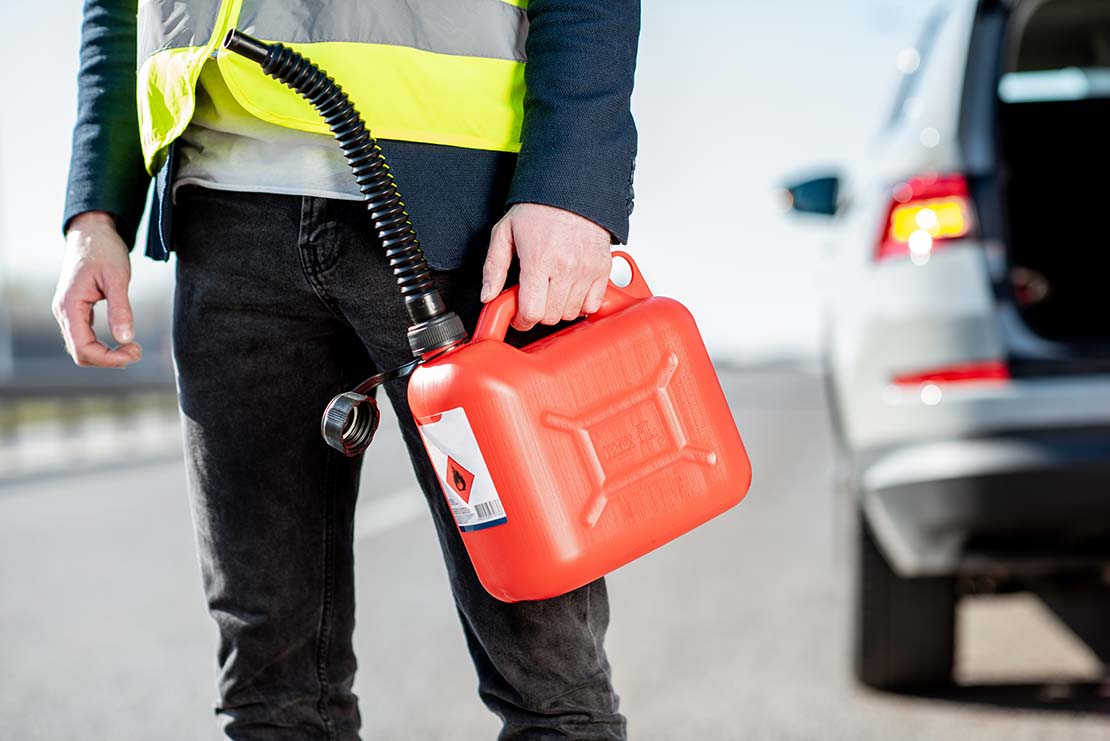
Within Germany:
- Maximum 60 liters per reserve canister. The maximum quantity per vehicle must not exceed 240 liters.
This quantity applies per vehicle, not per person.
Source: https://www.adac.de/verkehr/tanken-kraftstoff-antrieb/tipps-zum-tanken/reservekanister/
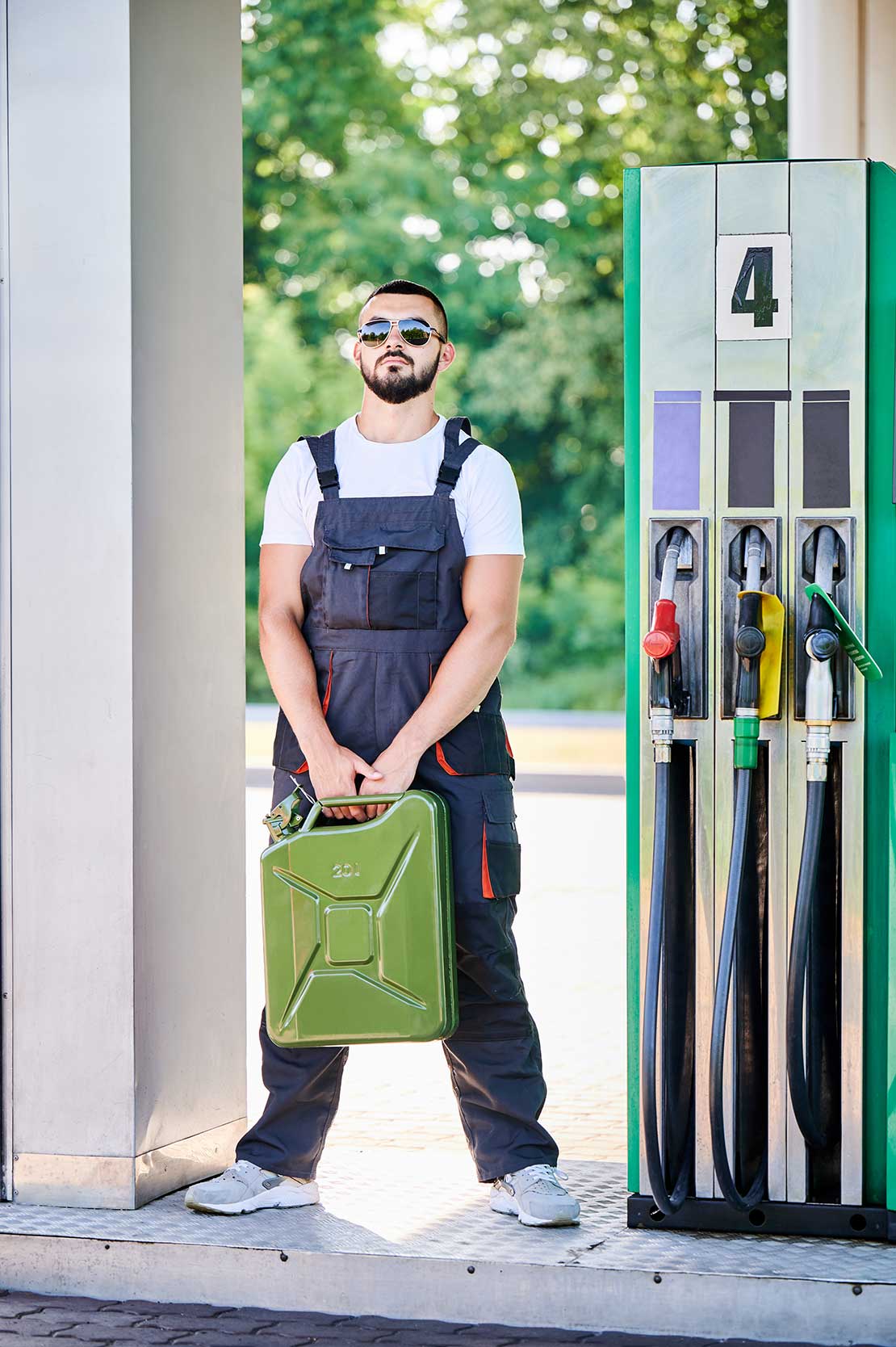
Criteria:
- Canisters must be UN-certified
- Must be secured (e.g. in the trunk, not loose in the interior)
- Must be tightly sealed
- No storage in the vehicle for several days
Why this limit?
A car is not a hazardous goods transporter. In the event of an accident, the hazard must remain limited.

How to store fuels correctly - Professional prepper practice
Correct storage determines how long gasoline and diesel actually remain usable.
The right container
Recommended:
- Metal canisters with UN approval
- Sturdy plastic canisters (HDPE) also permitted, but less ideal
Important:
- Canisters should not be older than 10-15 years
- Check seals regularly
- Always seal airtight
Temperature conditions
Optimal:
- 5 to 15 °C
- No direct sunshine
- No strong temperature fluctuations
Heat and UV light greatly accelerate ageing.
Choice of location
Ideal:
- Garage
- Separate storage room
- Garden shed (if permitted and well ventilated)
- Concrete floor
- No spark sources
Not suitable:
- Cellar (often prohibited by law)
- Apartment
- Attic
Label canisters
Always make the following information visible:
- Content (gasoline / diesel)
- Date of storage
- Additive / Stabilizer
- Planned exchange offer (e.g. „Rotation date month/year“)
Rotation system („First In - First Out“)
One of the most important tips.
Example:
- You store 40 liters of gasoline.
- Every year you use up your oldest 20 liters and fill up with 20 liters of fresh water.
So you always have usable fuel - even without long-term risks.
Storage in winter
Gasoline: unproblematic
Diesel: risk of kerosene precipitation (flaking in cold weather)
Remedy:
- Winter diesel or
- Additives that improve low-temperature stability
What happens when gasoline or diesel goes bad?
Old gasoline
Features:
- Engine starts badly
- Loss of performance
- Unsteady engine running
Cause:
- Highly volatile components are missing
- Oxidation has taken place
Old diesel
Problems:
- Slimy, dark coating
- Filter clogged
- Engine gets too little fuel
Worst case scenario: diesel plague with slimy biofilms.
Disposal of old fuels
Important:
Never dispose of down the drain or rainwater drain!
Disposal via:
- Recycling centers
- Mobile hazardous waste collection
- Specialist companies
Practical quantity recommendations for preppers
For the average single prepper:
- 20-40 liters of petrol or
- 40-100 liters of diesel
depending on the usage scenario.
For preppers with a generator:
- 60-200 liters of diesel/storage diesel using the rotation principle
For bug-out vehicles:
- 10-20 liters in the car only for the journey, not for permanent storage
- Store more at the bug-out location
Legal notice
This article describes the general status of regulations and typical garage ordinances in Germany.
As the federal states may have their own detailed rules, it makes sense to ask locally - especially if you want to store larger quantities.
 Deutsch
 English